
Xpert™ Lubrication Benchmark Audit
- A structured, scored evaluation of your lubrication management program measured against industry best practices.
Identify Where You Stand - and What Comes Next
Most organizations understand that lubrication affects reliability, but few have a clear, measurable method for evaluating how effective their program truly is. Even well-managed facilities often contain opportunities for meaningful improvement, from documentation gaps and contamination exposure to inconsistent training and lubricant consolidation.
The Xpert™ Lubrication Benchmark Audit provides a structured, scored evaluation of your lubrication management program across nine key performance categories. Using a 1 (not engaged) through 5 (excellence) scale, the audit establishes an objective baseline that clearly identifies strengths, gaps, and areas requiring attention.
This measurable approach provides asset managers and leadership teams with the clarity needed to justify improvements, prioritize investments, and track progress over time. The audit can be performed at any stage of your reliability journey and repeated periodically to measure advancement toward Lubrication Excellence.
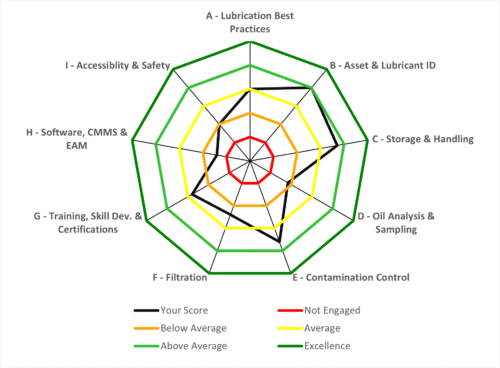
What the Benchmark Evaluates
Asset & Lubricant Identification
Evaluation of lubrication standards, procedures, and consistency across your organization.
Program Best Practices
Inspection of equipment surfaces, storage areas, and lubricant handling practices to identify contamination risks and environmental concerns.
Storage & Handling
Assessment of lubricant storage environments, transfer methods, and contamination risks.
Oil Analysis & Sampling
Review of sampling practices, testing programs, and fluid condition monitoring procedures.
Contamination Control
Assessment of contamination exclusion methods and cleanliness management standards.
Filtration Practices
Review of filtration systems and lubricant cleanliness optimization.
Training & Skill Development
Evaluation of personnel knowledge, certifications, and structured training programs.
Software, CMMS & EAM Integration
Assessment of lubrication scheduling, tracking, and asset management system alignment.
Safety & Accessibility
Review of safe lubrication execution and accessibility of lubrication points.
Common Questions
How long does a Benchmark Audit take?
The duration of an onsite lubrication survey depends on the size and complexity of the operation. Smaller facilities or targeted evaluations may be completed in a single day, while large industrial plants or multi-department operations can require three to five days. The scope of the survey, number of lubrication points, and level of documentation required all influence the timeline. Prior to scheduling, we define the survey boundaries to ensure the evaluation is thorough and aligned with your operational goals.
Do we need to shut down equipment?
In most cases, equipment shutdown is not required. Surveys are typically conducted while operations are running. However, certain machinery may require temporary access, such as removing safety guards to inspect lubrication points. When shutdown or access adjustments are necessary, this is discussed and coordinated in advance to minimize disruption.
Who from our team needs to be involved?
Following the survey, you will receive a detailed written report outlining findings and recommendations. The report summarizes current lubrication practices, identifies areas for improvement, and provides structured guidance designed to strengthen reliability and overall program performance.
How is the program scored?
Oil analysis is not automatically included as part of the survey. However, based on survey findings, oil analysis may be recommended as a follow-up service to validate lubrication practices, monitor contamination levels, and support predictive maintenance efforts.
Can the audit be repeated to measure improvement?
No specific documentation is required prior to the survey. The most important factor is access to a team member who understands the equipment and current lubrication practices. Any existing maintenance records or OEM information can be helpful, but they are not mandatory.
Additional Information
Establish Your Lubrication Baseline
Understanding where your program stands is the first step toward measurable improvement. Schedule a Benchmark Audit to gain objective insight and a clear path forward.